
OpMaint is built to help maintenance reliability professionals implement SMRP standards in daily operations automatically, digitally, and audit-ready.
Here is a scenario most maintenance managers know well.
A critical piece of equipment fails mid-shift. The team responds fast. The repair gets done. Production resumes.
But three hours of unplanned downtime just cost the facility significantly more than a scheduled maintenance visit would have.
Here is the deal.
That is not a maintenance failure. That is a system failure. A failure to operate within a structured, proven maintenance framework.
That framework has a name. And it is what the best-performing maintenance teams in the US are already using.
What is SMRP? It is the answer to that problem. And in this guide your team will learn exactly why it matters.
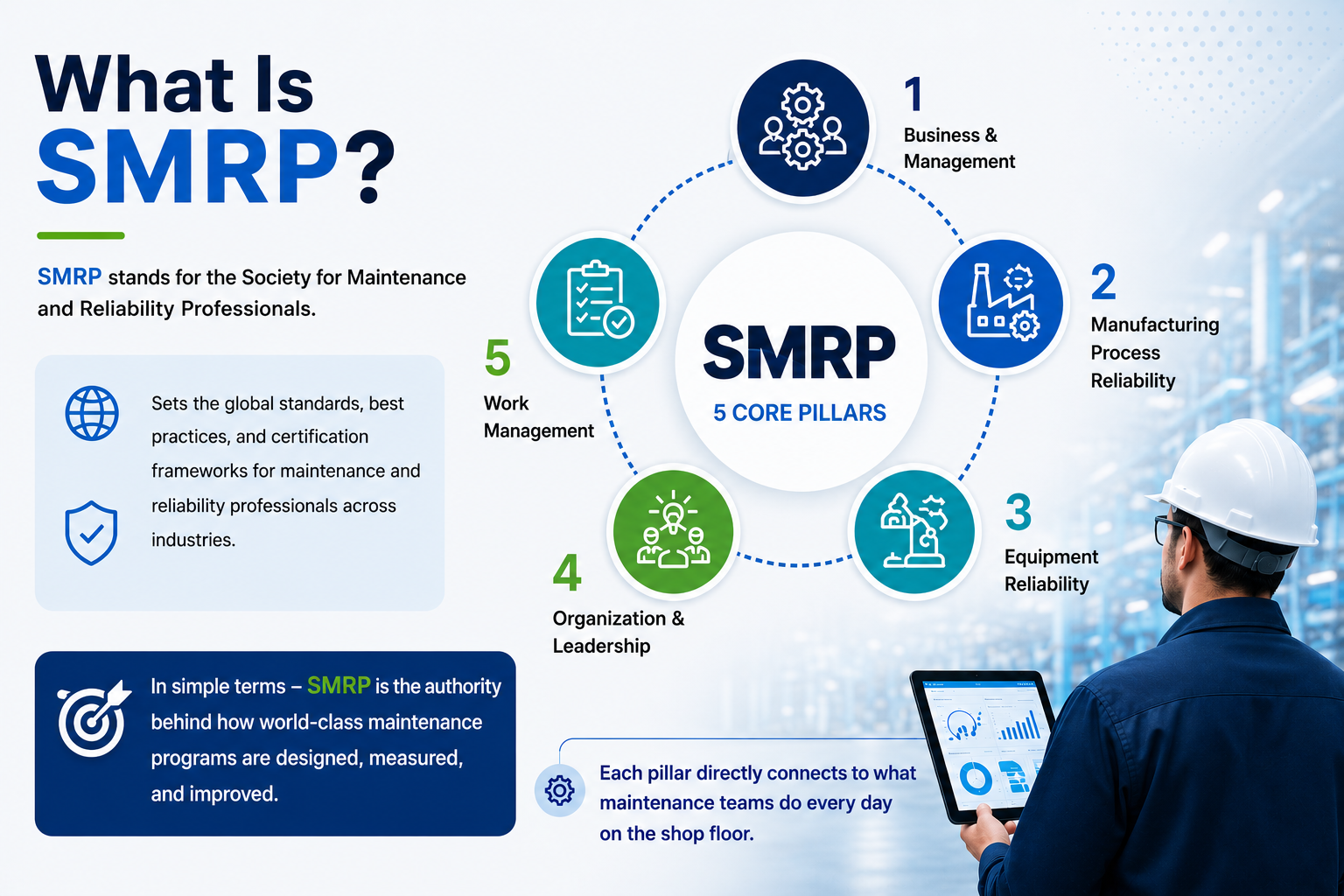
SMRP stands for the Society for Maintenance and Reliability Professionals. It is a US-based nonprofit organization founded in 1992 that sets the global standards, best practices, and certification frameworks for maintenance and reliability professionals across industries.
In simple terms - SMRP is the authority behind how world-class maintenance programs are designed, measured, and improved.
It covers five core pillars:
Every pillar connects directly to what maintenance teams do on the floor every single day.
Most maintenance teams operate without a structured framework. Tasks get done. Equipment gets fixed. But there is no consistent standard for how maintenance should be planned, executed, and measured.
SMRP maintenance changes that.
It gives maintenance teams a common language, a set of proven standards, and a measurement system that connects maintenance performance directly to business outcomes.
Here is why that matters in practice.
Without SMRP standards your team is making decisions based on experience and instinct. With them your team is making decisions based on data, benchmarks, and proven best practices.
The difference shows up in downtime numbers, maintenance costs, and equipment reliability. Every single month.
Is your team currently operating without a structured maintenance framework? Book Demo with OpMaint and see how food manufacturing and industrial teams are implementing SMRP standards with a CMMS built for daily operations.
Maintenance reliability professionals are the engineers, managers, and technicians responsible for keeping industrial equipment running efficiently, safely, and cost-effectively.
They work across manufacturing, food processing, facilities management, healthcare, utilities, and virtually every industry that depends on equipment to operate.
In the US these professionals are increasingly expected to operate within a structured framework, not just fix things when they break.
SMRP provides that framework. And SMRP maintenance certification through the CMRP credential validates that a professional has the knowledge to implement it correctly.
For organizations the value is clear. Maintenance reliability professionals trained in SMRP standards reduce downtime, lower maintenance costs, and improve equipment reliability in measurable ways.
Understanding reactive maintenance food manufacturing risks shows exactly what happens when facilities operate without certified maintenance reliability professionals applying structured standards.
This is where SMRP becomes especially relevant for food manufacturing maintenance teams.
SMRP standards require documented maintenance programs, structured work order management, and consistent equipment reliability tracking.
These are the exact same requirements that HACCP, FSMA, and OSHA demand from food facility maintenance operations.
The overlap is significant.
A maintenance team operating under SMRP standards is simultaneously building the documentation foundation required for regulatory compliance. One structured program covers both operational excellence and compliance readiness.
For food manufacturing teams this means haccp in food manufacturing compliance and SMRP operational standards are not separate programs. They are two outcomes of the same disciplined maintenance system.
Understanding cmms for osha compliance shows how the same digital maintenance system that supports SMRP standards also supports OSHA regulatory requirements simultaneously.
Here is the direct answer.
What is smrp used for in practice?
It is the operational framework your maintenance team follows to plan work, measure performance, improve reliability, and demonstrate value to the organization.
Specifically SMRP is used for:
Benchmarking : Comparing your maintenance performance against industry standards to identify where your program is strong and where it needs improvement.
Work Management : Structuring how work requests are received, prioritized, planned, scheduled, and completed with full documentation at every step.
Reliability Engineering : Applying systematic approaches to understand why equipment fails and designing maintenance strategies that prevent those failures from recurring.
Asset Management : Tracking equipment condition, history, and performance across the entire asset lifecycle from installation to replacement.
Performance Measurement : Using standardized SMRP metrics like planned maintenance percentage, schedule compliance, and equipment availability to drive continuous improvement.
Every one of these applications maps directly to a core OpMaint feature. Asset Management Use Cases shows how OpMaint supports the asset management pillar of SMRP standards in food manufacturing and industrial environments.
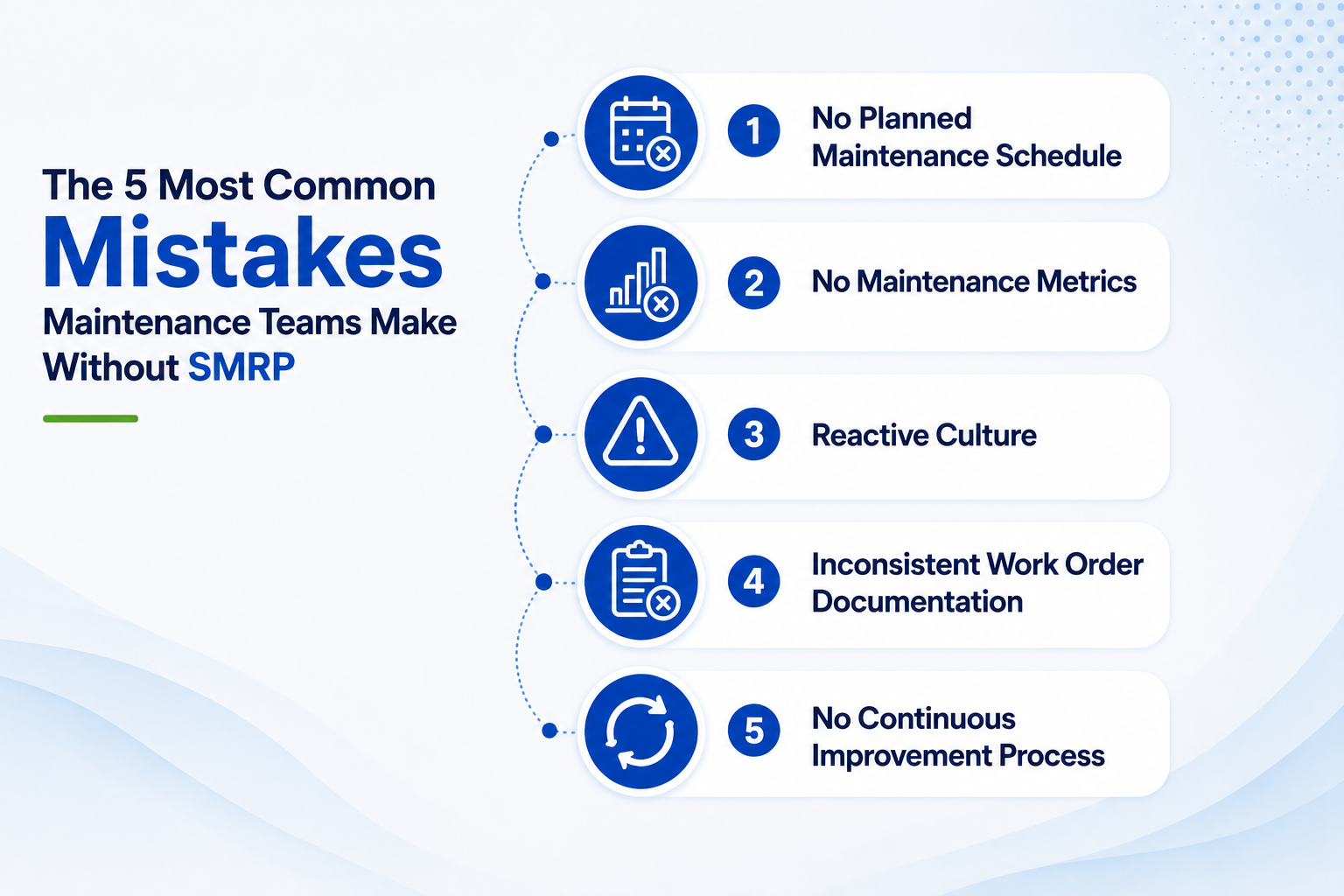
These are not hypothetical.
These are the operational failures that maintenance teams without a structured framework repeat consistently.
Mistake 1: No Planned Maintenance Schedule Work only happens when something breaks. Costs are unpredictable. Downtime is frequent. Equipment ages faster than it should.
Mistake 2: No Maintenance Metrics The team has no way to measure whether performance is improving or declining. Decisions are based on gut feel not data.
Mistake 3: Reactive Culture The maintenance team is always in firefighting mode. There is never time to plan because there is always an emergency to handle.
Mistake 4: Inconsistent Work Order Documentation Some tasks get documented. Some do not. The maintenance history is incomplete and unreliable for audits, warranty claims, or root cause analysis.
Mistake 5: No Continuous Improvement Process The same equipment fails for the same reasons repeatedly because nobody has the data or the framework to identify and eliminate root causes.
SMRP standards eliminate all five of these failure patterns by giving maintenance teams a structured framework that makes disciplined operations the default not the exception.
Here is the bottom line.
OpMaint is Manufacturing CMMS Software built for maintenance reliability professionals who need to implement SMRP standards in real daily operations not just on paper.
Here is exactly how OpMaint supports every core SMRP maintenance pillar:
Work Management : OpMaint digitizes every work request, work order, and task completion automatically. Every record timestamped. Every technician accountable. Every history traceable.
Preventive Maintenance : Automated PM scheduling ensures every asset is maintained on schedule before failures occur. Work orders generate automatically. Reminders go to the right technician. Nothing waits. Nothing gets missed.
Asset Management : Every asset in your facility carries a complete digital record in OpMaint. Condition history. Repair logs. Calibration dates. Performance trends. All in one place.
Performance Metrics : OpMaint reporting dashboards give maintenance managers real-time visibility into MTBF, MTTR, PM completion rates, and schedule compliance. The exact metrics SMRP requires you to track.
Continuous Improvement : OpMaint data gives your team the insights to identify recurring failures, adjust maintenance strategies, and demonstrate measurable improvement over time.
OpMaint is purpose-built for Restaurant CMMS Software needs and food manufacturing facilities that need a CMMS their maintenance teams will actually use on the floor every single day.
Is your team ready to implement SMRP standards with a CMMS built for it? Book Demo with OpMaint today and see how maintenance teams are turning SMRP frameworks into daily operational reality.
Here is the truth about smrp and why it matters for your maintenance team.
SMRP is not a certification you hang on the wall. It is not a document you file away. It is a living operational framework that transforms how your maintenance team plans, executes, and improves every single day.
The maintenance teams that consistently reduce downtime, lower costs, and pass audits are not the lucky ones.
They are the ones operating within a structured framework backed by SMRP standards and executed through a reliable digital system.
Stop reacting to failures. Start preventing them.
Got a question? We’ve got answers. If you have any other questions, please contact us via our support center.
.webp)

.jpeg)
