For facility managers, operations heads, and maintenance teams, tracking every asset can seem an impossible task. Lost tools, untracked equipment, and inefficient asset tracking can routinely cost precious time and money, thus throwing maintenance schedules into chaos. From manufacturing and retail to food and beverage and facilities management, there must exist a more intelligent way to manage assets relative to their effective utilization. Organizations implementing an organized strategy concerning Asset Inventory Management can enhance workflow, improve accountability, and make certain that every piece of equipment is tracked through its entire lifecycle.

Asset inventory management is the systematic tracking, monitoring, and controlling of the assets of an organization from acquisition to disposal. It involves accurate records, which include life-cycle assessment of the assets, and ensures that all tools and equipment are available on demand. A strong asset inventory management system allows teams to do the following:
With asset inventory software in place, all departments see their resources and minimize any possible loss of underutilized assets.Asset inventory management refers to the systematic process of tracking, monitoring, and controlling an organization’s assets from procurement to disposal, which begins with understanding asset management principles.
Many organizations tend to confuse asset management software with conventional inventory systems. Although both work to track resources, they serve very different purposes:
Asset Management Systems: Long-term monitoring of high-value equipment, which includes maintenance history, depreciation, and end-of-life management.
Inventory Management Systems: Typically deals with consumables and low-cost items, such as spare parts, PPE, or raw materials that often are focused on stock levels and order management.

Another proper aspect of asset inventory management is differentiating PPE from common inventory items:
Keeping records of both items helps in ensuring that your crew is never short of safety equipment or any important tools. An integrated Inventory Management platform along with your allows for simple and economical replenishment and monitoring.

Firms with modern asset inventory management tools report significant downtime reduction and operational productivity improvement. For the curious managers about the implementation, one should know the price of scalable solutions that differ based on the complexity of assets and number of users.
A firm grasp of the various stages in the Asset Lifecycle is essential for effective asset inventory management. Operational efficiency and cost management are positively or negatively impacted at various stages, ranging from procurement to deployment, maintenance, and finally disposal. Tracking the asset lifecycle enables maintenance teams to schedule timely inspections and plan preventive maintenance while maximizing the use of equipment prior to replacement. Asset management software will complement this process by enabling organizations to visualize asset health and prolong equipment life based on data-driven decisions that further improve productivity.
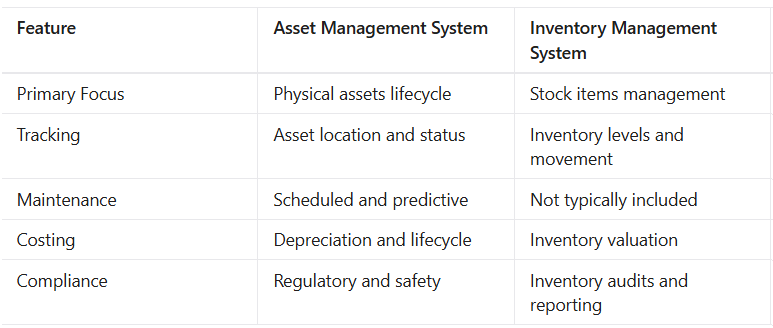
Understanding the difference will assist organizations in choosing the fitting platform or integrating both systems for smooth workflow management. Such an integration will collect data across an entire asset ecosystem and be a provider of returns on assets. Asset tracking tied to an order management system is an example where both tools and consumables are accounted smoothly.

These strategies ensure that teams engage in smart asset inventory management rather than reactive types that will boost both productivity and accountability.

Intelligent asset inventory management means creating efficient systems to track, maintain, and utilize all the assets across your organization. From cutting down on operational costs and reducing downtime to being compliant and safe via proper tracking of PPE, the advantages are numerous. Integrating asset tracking with asset management software and inventory management platforms streamlines workflows and enables maintenance teams to perform optimally.
Book your Demo with OPMAINT or get on with the program to see how smarter asset inventory management can alleviate the burden from maintenance management, leading to overall efficiency.
Got a question? We’ve got answers. If you have any other questions, please contact us via our support center.
.webp)

.jpeg)
