.svg)

.png)
There is a maintenance manager somewhere right now pulling data from three different spreadsheets trying to figure out why Line 4 went down for the third time this month.
Sound familiar?
Here is what that manager does not have:
Here is what they need.
A cmms smrp aligned system that turns maintenance best practices from a framework on paper into a daily operational reality.
That is exactly what this guide covers.
Not theory. Not frameworks. The exact solution maintenance managers across US manufacturing are using right now to stop the reactive cycle permanently.
You know the feeling.
Production stops. The phone rings. It is the plant manager.
Another unplanned breakdown. Another emergency repair. Another conversation about why it keeps happening.
The last PM on that asset was three months ago. It was supposed to be monthly.
Nobody missed it intentionally. The schedule was not automated. The task got deferred. Then forgotten.
That single gap just cost your facility hours of unplanned downtime.
US manufacturers lose 50 billion dollars annually to unplanned downtime.
The problem is not your team.
It is the system behind them.
A cmms maintenance reliability system aligned with SMRP best practices fixes this permanently.
Most maintenance managers have heard of SMRP.
The Society for Maintenance and Reliability Professionals sets the gold standard for maintenance program performance across US manufacturing.
But knowing SMRP best practices and actually implementing them in daily operations are two completely different things.
Here is the gap.
Implementing all five manually is impossible at scale.
cmms smrp alignment means using a CMMS specifically configured to execute every SMRP requirement automatically as part of your team's daily maintenance workflow.
The result is a maintenance program that does not just follow SMRP principles on paper.
It lives them every single shift.
For a complete breakdown of what SMRP requires from maintenance teams read our guide on what is smrp.
.png)
Let us be direct about what brings most maintenance managers to this page.
They are not searching for theory. They are searching for answers to real problems they face every single day.
More than two unplanned breakdowns per month means your PM program is not working. The answer is automated PM scheduling that prevents failures before they occur.
MTBF. MTTR. PMP. OEE. If calculating these requires manual data gathering you are always looking at yesterday's problems. The answer is real-time metric tracking built into your CMMS.
An auditor arrives. Six months of calibration records. Forty minutes of searching binders. The answer is digital records captured automatically and retrievable in seconds.
Breakdowns always feel more urgent than scheduled PM. So PM gets deferred. Equipment degrades. The answer is a system that makes planned maintenance the default not the exception.
You know the program is improving. But proving it takes two days of manual reporting. The answer is automated reporting that shows leadership exactly what maintenance is delivering.
Every one of these problems has one solution.
A cmms smrp aligned system that automates the execution, documentation, and measurement of your entire maintenance program.
Book Demo with OpMaint today and see exactly how each of these problems gets solved in a live system built for US maintenance teams.
Here is the direct connection between SMRP requirements and CMMS capabilities.
Not in theory. In practice.
What SMRP Requires: Maintenance resources concentrated on highest criticality assets. High criticality assets get more frequent and more thorough maintenance attention than low criticality assets.
What Most Teams Do: Treat all assets equally. Same PM frequency. Same priority. No criticality-based resource allocation.
What a CMMS Does: Stores criticality profiles for every asset. Automatically generates more frequent work orders for high criticality equipment. Flags overdue tasks on critical assets before they become failures.
What SMRP Requires: PM tasks designed around the specific failure modes of each asset. Not generic checklists. Asset-specific tasks that prevent known failures.
What Most Teams Do: Use the same generic checklist for every asset regardless of its failure history or failure modes.
What a CMMS Does: Stores asset-specific PM task libraries based on failure modes. Every work order includes the exact tasks designed to prevent that asset's known failures.
What SMRP Requires: Every maintenance task executed through a formal work order system with documented completion records.
What Most Teams Do: Paper work orders that get lost, go incomplete, or never make it back to the office.
What a CMMS Does: Generates work orders automatically. Enforces mandatory completion fields. Captures digital sign-offs and timestamps. Creates permanent searchable records.
A structured preventive maintenance schedule built into OpMaint ensures every work order is generated before due dates and completed with a full audit trail.
What SMRP Requires: Consistent tracking of MTBF, MTTR, PMP, OEE, and schedule compliance. Used to make continuous improvement decisions.
What Most Teams Do: Calculate metrics manually from spreadsheets at the end of each month. Or not at all.
What a CMMS Does: Calculates every SMRP metric automatically from work order data. Displays results in real time on a performance dashboard.
For a complete breakdown of every SMRP metric your team should be tracking read our guide on smrp metrics.
What SMRP Requires: Regular review of failure data and PM effectiveness. PM schedules adjusted based on real performance data not assumptions.
What Most Teams Do: Keep the same PM schedule year after year regardless of whether it is preventing failures.
What a CMMS Does: Tracks failure history per asset automatically. Makes trend data available for program review at any time. PM schedule adjustments made in minutes.
That is smrp best practices cmms alignment in action.
Here is something most maintenance managers do not calculate until it is too late.
The cost of not having the right system is not zero.
It is compounding every single month.
Every row in that table is money leaving your facility every month.
And every row is solved by a cmms maintenance reliability system aligned with SMRP standards.
Is your team operating in the left column right now? Book Demo with OpMaint and see exactly what moving to the right column looks like for your facility.
Here is the bottom line.
Not every CMMS is built for SMRP alignment.
Most are built for basic work order management.
OpMaint is Manufacturing CMMS Software built specifically for maintenance teams that need to implement SMRP best practices in their daily operations without adding administrative complexity to an already stretched team.
Here is what makes OpMaint different:
Built for the Production Floor Technicians use OpMaint on mobile devices directly on the production floor. Not at a desk. Not after the shift. At the point of work. That is where compliance records are created. That is where OpMaint captures them.
Automated Before It Is Urgent OpMaint generates work orders before due dates. Sends reminders before tasks become overdue. Alerts managers before calibrations lapse. The system is always one step ahead of the failure.
SMRP Metrics Without the Spreadsheet Every core SMRP metric calculated automatically from work order data. MTBF. MTTR. PMP. OEE. Schedule compliance. Real-time dashboard always available. No manual calculation. No end-of-month data gathering exercise.
PM That Prevents Not Just Records cmms preventive maintenance in OpMaint is built around asset criticality and failure modes. Not just time-based intervals. PM tasks are designed to catch the specific failure indicators that predict equipment failures before they occur.
Reporting That Proves Program Value Generate a complete maintenance performance report in minutes. Show leadership exactly what the maintenance program is delivering. Cost saved. Downtime prevented. PM compliance achieved. Work orders completed. All in one report. No manual work.
The work order management software built into OpMaint gives maintenance teams the structured work execution platform that SMRP best practices require.
.png)
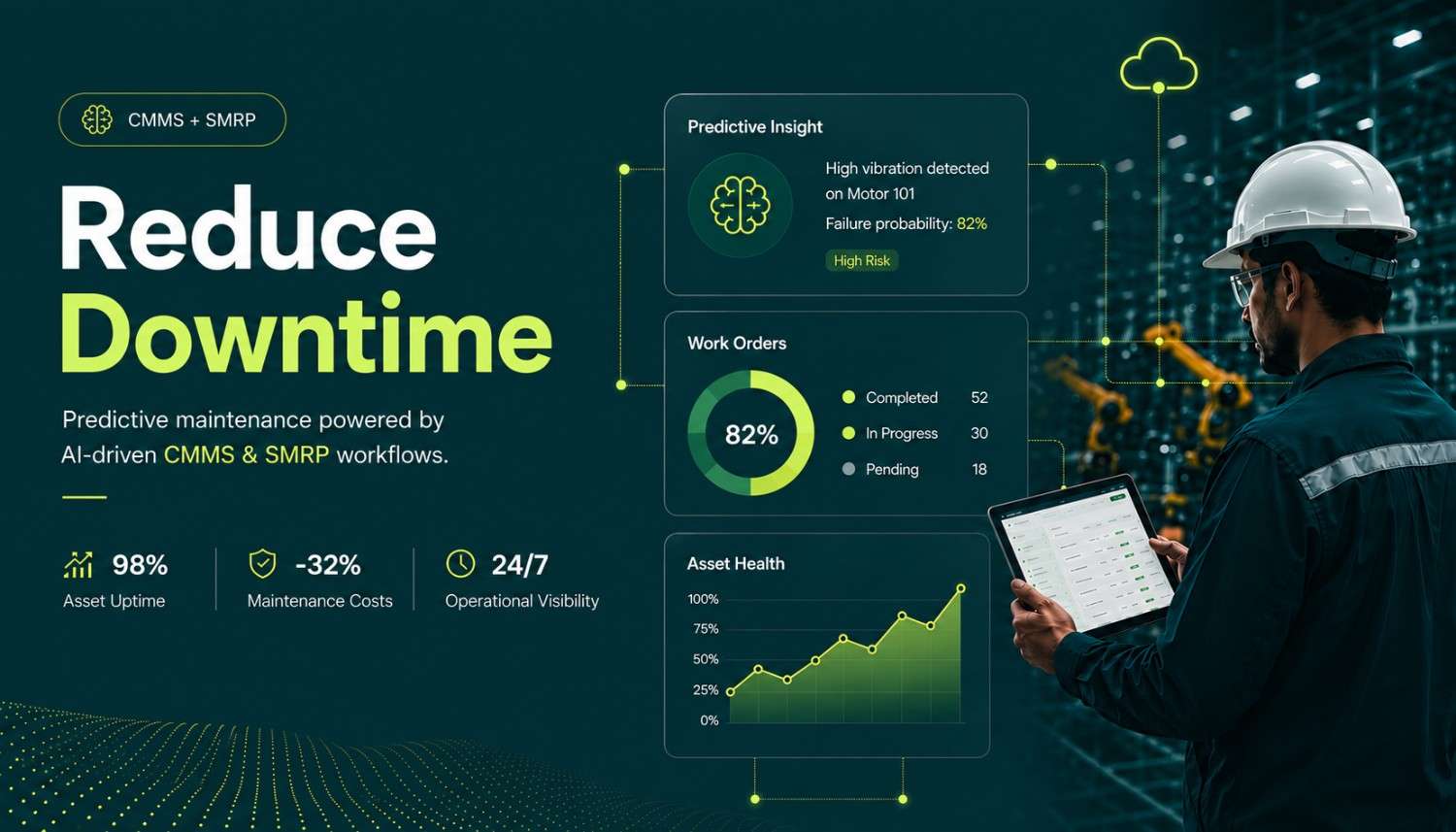
reduce downtime cmms is not just a feature of OpMaint.
It is the outcome that every feature is designed to deliver.
Here is exactly how:
Predictive Scheduling Prevents Failures Assets maintained on optimized schedules before failures occur. MTBF data used to refine PM intervals continuously. High criticality assets never go unmaintained.
Real-Time Alerts Stop Gaps Before They Become Failures Overdue PM tasks flagged immediately. Calibration due dates alerted before expiry. Corrective action workflows triggered automatically on deviation. Your team knows about problems before production does.
Digital Records Eliminate Compliance Scrambles Every maintenance record captured digitally at point of work. Full audit trail always available. No scrambling before inspections. No missing records that create compliance risk.
Performance Data Drives Continuous Improvement SMRP metrics tracked automatically. Failure trends identified early. PM schedules adjusted based on real data. The program gets better every month because the data to improve it is always available.
For a complete understanding of how preventive maintenance strategies reduce downtime in US manufacturing read our guide on preventive vs reactive maintenance.
SMRP certified maintenance professionals consistently identify one gap between certification knowledge and operational reality.
The gap is execution.
Knowing SMRP principles is not the challenge.
Executing them consistently across every shift, every asset, and every technician in a busy production environment is.
That is the gap a maintenance management software smrp aligned system closes.
The most effective maintenance management software smrp implementations share three characteristics:
OpMaint is designed to meet all three criteria for US maintenance teams operating in manufacturing and food processing environments.
The smrp best practices guide gives your team the complete framework for configuring OpMaint around every SMRP requirement.
Before your next planning meeting ask yur team these three questions.
Question 1: Can you pull the MTBF trend for your five most critical assets right now without opening a spreadsheet?
If the answer is no your metric tracking is not giving you the real-time visibility SMRP requires.
Question 2: How many PM tasks were deferred last month and why?
If you cannot answer this without manually reviewing work order records your schedule compliance visibility has gaps.
Question 3: If an auditor walked in right now how long would it take to produce six months of maintenance records for any asset in the facility?
If the answer is more than five minutes your documentation system is a compliance risk.
Every no and every answer that takes longer than it should is a signal that your current system is not aligned with SMRP best practices.
OpMaint turns every no into a yes. Automatically.
smrp best practices cmms alignment is not a long implementation project.
It is a configuration exercise that your team can complete in days with OpMaint's onboarding support.
And once configured the system runs your maintenance program automatically while your team focuses on the work that actually matters.
The maintenance managers who consistently reduce downtime, pass audits, and deliver measurable ROI to leadership are not the ones working hardest.
They are the ones with the right system behind them.
A cmms smrp aligned system that schedules automatically, documents completely, measures continuously, and improves consistently.
That system is OpMaint.
The reduce downtime cmms platform built specifically for US maintenance teams that need to implement SMRP best practices without adding complexity to an already demanding operational environment.
Every day without the right system is another day of:
The system your maintenance program needs already exists. It is called OpMaint.
Book Demo with OpMaint today and see how US maintenance teams are implementing SMRP best practices automatically, reducing unplanned downtime by up to 30 percent, and building maintenance programs that deliver measurable results every single month.
.webp)

.jpeg)